AI image generation is moving so fast that choosing the “best” model is no longer simple.
A year ago, the question was easy: Which tool makes the most beautiful image?
Today, that question is too shallow.
If you are a creator, marketer, founder, designer, or AI tool builder, the real question is:
Which image model fits your actual workflow?
That is why the comparison between GPT Image 2 and Nano Banana 2 matters.
Both models are powerful. Both can create high-quality images from text prompts. Both can edit existing images. Both can help you make thumbnails, product visuals, ad creatives, social media images, character references, and concept art.
For creators who want to test this workflow directly, GPT image 2 is a practical starting point for generating polished visuals from prompts. And if your work depends more on editing an existing image, changing a scene, or creating variations from a reference, an ai image to image generator can be even more useful than starting from a blank prompt.
But GPT Image 2 and Nano Banana 2 do not feel the same.
GPT Image 2 feels more like a reasoning-driven creative assistant. It is strong at understanding complex prompts, handling layout instructions, rendering text, and turning vague ideas into structured visual outputs.
Nano Banana 2 feels more like a fast, polished, production-friendly image model. It is especially attractive when you care about speed, photorealism, clean visuals, and high-resolution output.
In this article, I’ll break down GPT Image 2 vs Nano Banana 2 from a practical point of view: image quality, prompt understanding, text rendering, editing ability, character consistency, speed, pricing, and real-world use cases.
What Is GPT Image 2?
GPT Image 2 is OpenAI’s newer image generation model, designed for both image creation and image editing.
The biggest advantage of GPT Image 2 is not just that it can generate beautiful images. The real advantage is how well it understands instructions.
When you give it a detailed prompt, it usually does a good job of following the structure. If you ask for a poster with specific text, a product scene with multiple objects, or a comic-style layout with panels and captions, GPT Image 2 tends to handle those complex visual requirements better than many older image models.
This makes GPT Image 2 useful for:
- Marketing posters
- Social media creatives
- Product mockups
- Visual explainers
- Infographics
- Character concept sheets
- Text-heavy graphics
- AI image editing workflows
In simple words, GPT Image 2 is not only an image generator. It is closer to a visual reasoning model.
That is a huge deal if your prompt includes many requirements.
For example, if you ask for “a clean SaaS landing page hero image showing a dashboard, three floating feature cards, readable UI labels, soft studio lighting, and a modern blue-purple gradient background,” GPT Image 2 is more likely to understand the whole composition instead of only generating a nice-looking random tech image.
What Is Nano Banana 2?
Nano Banana 2 is Google’s newer image generation model, commonly associated with the Gemini image generation ecosystem.
Its biggest strengths are speed, realism, clean composition, and high-resolution output. Nano Banana 2 is often discussed as a model that can generate more polished, natural, and production-friendly images with less waiting time.
If GPT Image 2 feels like a creative director, Nano Banana 2 feels more like a fast visual production engine.
It is especially useful for:
- Photorealistic portraits
- Product photography
- Lifestyle images
- Fast creative testing
- Clean commercial visuals
- High-resolution image generation
- Image restoration and enhancement
- Brand-friendly visual assets
Nano Banana 2 is also attractive because it fits naturally into Google’s broader AI ecosystem. For many users, the value is not only the model itself, but how it connects with Gemini-style multimodal workflows.
If you are already using Google tools, Nano Banana 2 may feel easier to adopt.
GPT Image 2 vs Nano Banana 2: Quick Comparison
Here is the simple version.
GPT Image 2 is better when you need complex instruction following, text rendering, structured layouts, and creative reasoning.
Nano Banana 2 is better when you need speed, polished realism, clean commercial images, and fast iteration.
Neither model is always better.
The better choice depends on what you are trying to create.
If you are making a YouTube thumbnail with big readable text, product callouts, and a specific layout, GPT Image 2 may be the better choice.
If you are making a realistic fashion photo, product lifestyle image, or polished cinematic portrait, Nano Banana 2 may be the better choice.
1. Image Quality
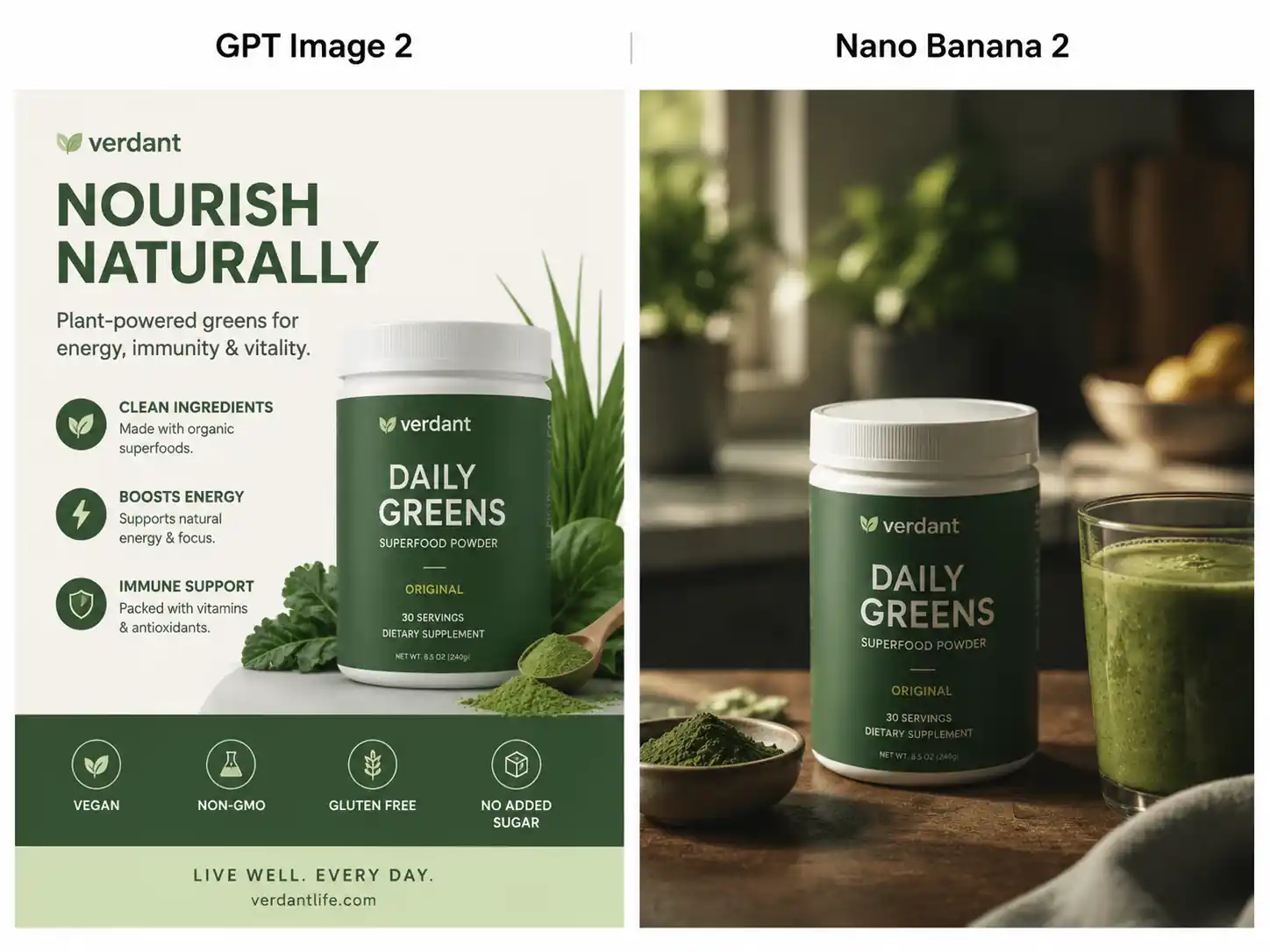
Both GPT Image 2 and Nano Banana 2 can create high-quality images.
But the style of quality is different.
GPT Image 2 often produces images with stronger composition logic. It is good at arranging visual elements in a way that matches the prompt. It can create images that feel more intentionally designed, especially when the prompt includes layout, text, objects, and specific relationships between elements.
Nano Banana 2 often produces images that look cleaner, faster, and more polished at first glance. It can be very strong for realism, lighting, and commercial-style images. If you want a beautiful image quickly, Nano Banana 2 is a strong option.
Here’s the practical difference:
GPT Image 2 is better for “I need this image to communicate a specific idea.”
Nano Banana 2 is better for “I need this image to look realistic, clean, and polished.”
For blog covers, ads, thumbnails, and visual explainers, GPT Image 2 can be very powerful.
For product photos, portraits, lifestyle scenes, and realistic visual content, Nano Banana 2 can be very impressive.
2. Prompt Understanding
This is one of the biggest differences.
GPT Image 2 is strong at understanding complex prompts. If your prompt has multiple layers, it usually performs well.
For example:
“Create a 4:3 blog cover image comparing GPT Image 2 and Nano Banana 2. Put GPT Image 2 on the left and Nano Banana 2 on the right. Use a futuristic studio background. Add a central VS symbol. Keep the text minimal and readable.”
This type of prompt requires the model to understand layout, symmetry, text placement, and visual hierarchy.
GPT Image 2 is usually better at this kind of structured visual reasoning.
Nano Banana 2 is also good at prompt following, but it may sometimes focus more on the overall visual quality than strict instruction execution. That can be a good thing when you want beautiful results, but a problem when you need exact control.
If you are building an AI image workflow where users expect predictable outputs, GPT Image 2 may be easier to guide.
3. Text Rendering
Text rendering is one of the most important areas for real-world AI image generation.
Many image models can create beautiful pictures, but fail when you ask them to include readable words.
This matters because real creators often need:
- YouTube thumbnail text
- Poster titles
- Product labels
- UI mockups
- Infographic text
- Social media captions
- Brand slogans
- Packaging mockups
GPT Image 2 is generally stronger for text-heavy images. It tends to follow typography instructions more reliably and can handle layouts where text is part of the design.
Nano Banana 2 can also produce text, but GPT Image 2 is usually the safer choice when readable text is mission-critical.
So if your image includes important words, headlines, labels, or UI elements, start with GPT Image 2.
That one decision can save you a lot of regeneration time.
4. Image Editing
Both models can edit images, but they feel different.
GPT Image 2 is strong when you want instruction-based editing. You can ask it to change a background, adjust an object, modify a character, or redesign a scene while keeping the core idea.
It is especially helpful when the edit is not just a simple change, but requires understanding the context.
For example:
“Keep the same person and pose, but change the background into a modern office, make the lighting softer, and turn the outfit into a professional business style.”
GPT Image 2 is good at understanding that type of edit because it can reason through the relationship between the subject, background, clothing, and overall style.
Nano Banana 2 is strong for fast, polished edits and realistic transformations. It can be very useful for image enhancement, restoration, and natural-looking edits.
So the difference is:
Use GPT Image 2 when the edit requires deeper instruction understanding.
Use Nano Banana 2 when the edit needs to be fast, clean, and visually polished.
5. Character Consistency
Character consistency is another important use case.
If you are making storyboards, comics, brand mascots, AI influencers, or repeated social media characters, you need the model to keep the same face, outfit, and identity across multiple images.
GPT Image 2 can perform well when the prompt clearly defines the character and the scene. It is useful for character sheets, storytelling images, and creative direction.
Nano Banana 2 can also be strong for character consistency, especially when using reference images or image-to-image workflows.
In practical use, Nano Banana 2 may be very attractive for creators who want fast variations of the same person or product. GPT Image 2 may be stronger when the scene itself is more complex and requires careful instruction following.
For simple character variations, Nano Banana 2 can be efficient.
For complex storytelling scenes, GPT Image 2 can be more reliable.
6. Speed and Iteration
Speed matters more than people think.
If you are only generating one image, waiting a little longer may not matter.
But if you are testing 30 thumbnails, 50 product shots, or 100 ad creatives, speed becomes a serious workflow factor.
Nano Banana 2 is often positioned as a faster option. This makes it useful for rapid testing and high-volume creative production.
GPT Image 2 may be more valuable when quality and instruction accuracy matter more than raw speed.
Here’s a simple way to think about it:
Nano Banana 2 is great for fast creative exploration.
GPT Image 2 is great for high-control image generation.
If you are brainstorming, Nano Banana 2 may help you move faster.
If you are producing final assets, GPT Image 2 may help you reduce errors.
7. Pricing and Workflow Cost
Pricing can vary depending on where you access the models, the quality settings, API provider, image size, and generation mode.
But the bigger point is this:
The cheapest model is not always the cheapest workflow.
If a model gives you the right image in two tries, it may be cheaper than a faster model that takes ten tries.
GPT Image 2 may be more cost-effective when your prompt is complex and you need accurate output.
Nano Banana 2 may be more cost-effective when you need many fast variations and the task is visually straightforward.
For example, if you are generating 100 lifestyle product images, Nano Banana 2 may be a better production tool.
But if you are creating a detailed infographic, a thumbnail with exact text, or a complex marketing poster, GPT Image 2 may save time because it understands the request better.
Cost is not just price per image.
Cost is price per usable image.
That is the metric that matters.
Best Use Cases for GPT Image 2
You should use GPT Image 2 when you need precision, structure, and instruction-following.
It is especially good for:
- Blog cover images
- YouTube thumbnails
- Posters with readable text
- Infographics
- UI-style visuals
- Product comparison graphics
- Comic panels
- Educational diagrams
- Marketing creatives
- Complex image edits
GPT Image 2 is a strong choice when the prompt has many details and the final image needs to communicate something clearly.
If your image is part of a marketing funnel, landing page, article, or ad campaign, GPT Image 2 may be the safer default.
Best Use Cases for Nano Banana 2
You should use Nano Banana 2 when you need speed, realism, and polished commercial visuals.
It is especially good for:
- Product photography
- Fashion images
- Lifestyle scenes
- Portraits
- Realistic social media content
- Fast creative testing
- High-resolution visuals
- Image restoration
- Brand moodboards
- Visual variations
Nano Banana 2 is a strong choice when the image needs to look beautiful quickly.
If you care about natural lighting, realism, cinematic style, and fast iteration, Nano Banana 2 is a great option.
Which One Should You Choose?
Here is my practical recommendation.
Choose GPT Image 2 if you care about control.
Choose Nano Banana 2 if you care about speed and polish.
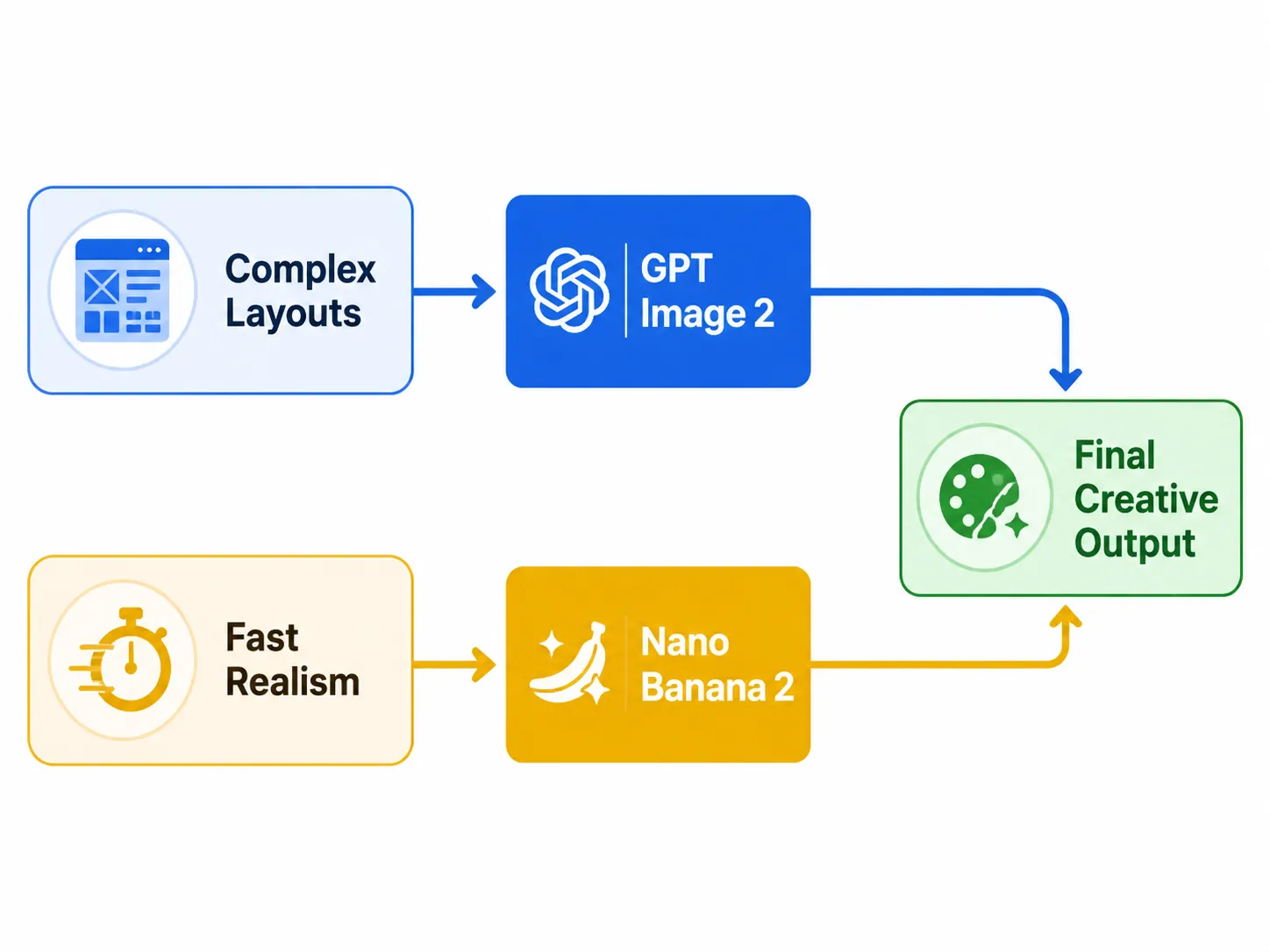
Choose GPT Image 2 for text, layouts, posters, thumbnails, infographics, and structured marketing images.
Choose Nano Banana 2 for portraits, product visuals, lifestyle scenes, high-resolution outputs, and fast creative testing.
But the best workflow is not choosing only one.
The best workflow is routing tasks to the right model.
For example:
Use GPT Image 2 to create a structured ad concept with headline text and layout.
Then use Nano Banana 2 to generate polished lifestyle variations.
Or use Nano Banana 2 to create a realistic product scene.
Then use GPT Image 2 to turn it into a campaign poster with text, labels, and a stronger composition.
That is where AI image generation becomes powerful.
Not one model for everything.
The right model for the right job.
The Bottom Line
GPT Image 2 and Nano Banana 2 are both excellent AI image generators, but they are built for slightly different creative workflows.
GPT Image 2 is better when you need structured thinking, complex prompt understanding, readable text, and strong layout control.
Nano Banana 2 is better when you need speed, realism, clean commercial visuals, and fast creative iteration.
If you are a creator, marketer, or founder, do not ask, “Which model is better?”
Ask, “Which model gives me the most usable output for this specific task?”
That question will save you time, money, and frustration.
For most real-world workflows, my answer is simple:
Use GPT Image 2 when the image needs to communicate clearly.
Use Nano Banana 2 when the image needs to look polished quickly.
And if you can use both, you will have a much stronger creative workflow than relying on one model alone.
References